
 English
 Español
 العربية
 ไทย
ไทย

jalur perakitan peralatan makan komersial
A commercial dishware assembly line is designed to efficiently produce large quantities of plates, bowls, cups, and other ceramic or porcelain items with consistent quality. The process typically begins with raw materials such as clay, feldspar, quartz, and kaolin, which are carefully measured and mixed. These ingredients are blended with water in large mixers to form a homogeneous slurry or plastic clay body, depending on the forming method to be used.Once the clay body is prepared, it is shaped into dishware using different forming techniques. For plates and shallow items, the most common method is ram pressing or isostatic pressing, where clay is compressed in molds under high pressure to achieve precise dimensions and thickness. For cups, mugs, and bowls, jiggering or jollying on rotating molds may be used, or slip casting can be applied: liquid clay, called slip, is poured into plaster molds that absorb water and leave a solid layer inside the cavity. Excess slip is drained, and the semi-formed piece is left to stiffen.After forming, the greenware (unfired pieces) move along conveyor systems to trimming stations. Here, automated or semi-automated tools refine the edges, foot rings, and attachment points such as handles. Handles for cups or mugs may be formed separately using extrusion or small molds and then attached by skilled workers or robotic arms applying slip as an adhesive. At this stage, logo impressions or texture patterns can also be applied with stamps, rollers, or embossing tools integrated into the line.The shaped and trimmed pieces then undergo a controlled drying process. They are placed on racks or continuous drying tunnels where temperature, humidity, and air circulation are carefully regulated. Proper drying is crucial to prevent warping or cracking during firing. Sensors and programmable controllers monitor the conditions and adjust them to match the clay body and item thickness.Once dry, items are loaded onto kiln cars or mesh belts for the first firing, called the bisque firing. This step burns out organic materials, hardens the ware, and prepares the surface for glazing. The firing temperature and schedule vary, but are typically between 900°C and 1000°C for commercial dishware. After cooling, the bisque ware proceeds to the glazing section.In the glazing area, automated spray booths, waterfall glazing curtains, or dipping tanks apply a uniform layer of glaze. The line may include rotating supports that spin each piece to ensure even coverage. Excess glaze is recovered and filtered for reuse. At this stage, decoration such as colored patterns, decals, or underglaze prints can be added using printing machines or transfer applications synchronized with the conveyor speed.Glazed pieces are then subjected to a second firing, often at higher temperatures, to mature the glaze and develop the final surface properties, including gloss, color, and durability. Fast-firing tunnel kilns or intermittent shuttle kilns are used, depending on production volume and flexibility requirements. Temperature profiles are tightly controlled by computerized systems to ensure consistent results.After the final firing, pieces undergo inspection under strong lighting. Automated vision systems and trained inspectors check for defects such as pinholes, glaze runs, color deviations, warpage, and cracks. Conforming products move on to sorting and packing areas, where robotic or manual systems group items into sets, add protective packaging, and prepare cartons for shipping. Throughout the line, data collection and quality control procedures ensure that the dishware meets commercial standards for strength, chip resistance, and food safety.
Produk
Kategori:
-
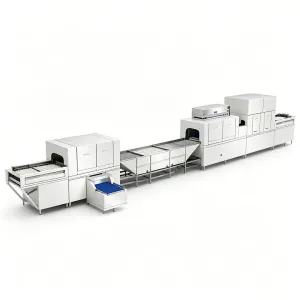
Jalur Perakitan Pengeringan Disinfeksi Pencucian Piring Komersial Skala Besar
Klasifikasi mereka: Seri Pencuci PiringTampilan: 10Nomor:Waktu rilis: 2026-04-20 14:35:01Jalur perakitan pengeringan desinfektan pencuci piring komersial berskala besar ini mewujudkan pencucian, desinfeksi, dan pengeringan otomatis yang terintegrasi. Perusahaan ini secara efisien memproses peralatan makan dalam jumlah besar, menghemat biaya tenaga kerja, dan memenuhi persyaratan kebersihan katering yang ketat.
Berita
Kategori:
Tidak ada hasil pencarian!
Kasus
Kategori:
Tidak ada hasil pencarian!
Video
Kategori:
Tidak ada hasil pencarian!
Download
Kategori:
Tidak ada hasil pencarian!
Rekrutmen
Kategori:
Tidak ada hasil pencarian!
Produk yang direkomendasikan
Tidak ada hasil pencarian!



 ada apa
 Telepon